
The Return: A Yoruba Play of Exile, Tradition and a Contested Throne

The Return: A Yoruba Play of Exile, Tradition and a Contested Throne
A three-act stage drama in which a spared heir, a loyal friend and a divided palace test what tradition demands
Dotun Olufokunbi is a native of Ilesha, in Osun State, south-western Nigeria. He grew up in the staff quarters of Obafemi Awolowo University, Ile-Ife, where, in his words, he was exposed to works of literature from an early age, and he went on to take a Bachelor of Arts in English Language at the same university. He is presently studying for a Master's degree at Edinburgh Napier University in Scotland. The Return is his play in three acts, and it grew out of his reading about Yoruba culture as it was practised in the old Oyo Empire. This feature looks closely at that play: its structure, its people, its language and the questions it puts to the reader.
A Play in Three Acts
The Return is a stage play and is best approached as one. The text opens with a title page, a dedication, an author's note headed “About Play” and a cast list, then moves through three acts: five scenes in Act One, four in Act Two and two in Act Three. A single inset scene, marked as a cutback, interrupts the final act and takes the action briefly away from the palace.
The cast includes Aremo Adegbite, the son of the former king; Makin, his close friend; Oba Akesua, the present king; Adeleke, the king's son; Olori Abeke, the queen; and chiefs including Otun and Bashorun. Ajoke, the queen's maidservant, Oyebade, Adegbite's hatchetman, and Ekun, a warrior in his following, join villagers, warriors, a herbalist and a Narrator.
The stage directions describe light, music, dress, objects and the movement of groups, and on the page they do much of the work that description does in prose.
Where the Play Began: The Author's Account
The author's note explains the play's origin. He describes it as born of curiosity and an inquisitive mind, and he names the reading that set it off: a book titled Nigeria and her Neighbours, and within it a portion on the history of the Yorubas, with particular attention to the Oyo Empire around 1700. The tradition of the Oyo people concerning the king and his first son fascinated and astonished him, and his pondering of it gave birth to the play.
In a further statement, Olufokunbi adds that Ile-Ife is generally revered as the origin of all the Yorubas, while the Oyo Empire is also of great importance in Yoruba history. He names as his starting point the common practice of getting rid of the Aremo alongside the king. In the play, he says, he tries to speak about Yoruba cultural and traditional practices, especially in relation to kingly succession, and the play seeks to explain how the Yorubas maintain peace during the reign of one king and keep overly ambitious princes in check.
The note is candid about the play's status. The author calls it “a work of imaginative narration”, so it is offered as drama rather than as historical record. It also explains that among the Yorubas the first son of a king is called the Aremo, and it carries a second custom into the play: when a king dies, the incoming king takes as his wives the women already in the palace. The note ends by promising its central figure a harsh reality and a surprise, and it leaves the rest for the reader.
The Aremo Tradition at the Heart of the Story
The Narrator opens the play with its premise. Igotun, he says, is a prosperous village affiliated to the old Oyo Empire, and the year is around 1723, a date the stage directions repeat for the scenes in Ilesha and in the palace. By the usual tradition, when the king dies, his first-born son, the Aremo, must die with him, because the Aremo is expected to have ruled alongside his father. The Narrator calls this horrendous and asks who dares question tradition.
When Oba Adehun dies, his son Adegbite is still young and is considered too innocent to be buried alive. Against tradition, and against the will of the chiefs, he is exiled to Ilesha, three days' journey on foot from Igotun. More than two decades pass before the first scene. There he has lived under the protection of Jagunmolu, a warrior of Ijesha land and the father of Makin. When Adegbite tells Makin who he is, he produces a necklace carrying a carved head, and Makin calls the practice an ill tradition that must be stopped.
The play does not leave the tradition unexamined. In Act Two, Olori Abeke gives Makin a different account of its purpose. The Oba rules with his son, she says, so that the Aremo does not grow too ambitious and kill his father to take the crown, and she adds that history records such a case. The tradition is therefore seen from two positions: as an injustice that has shaped Adegbite's life, and as a safeguard explained from inside the palace. The play invites readers to weigh the two.
Act by Act: How the Play Moves
Act One establishes the conflict. Adegbite tells Makin that he means to claim his throne “either easily or by duress”, and Makin pledges support even though it means postponing his own marriage. In Igotun, Otun reports a message from Adegbite and urges a peaceful settlement, while Bashorun demands war and names a hill by the village of Ipara as the place to meet. Adegbite's side prevails in the battle, which the directions stage through flickering light and drumbeats, so that the fighting is heard and glimpsed rather than shown in full. The last two scenes show the palace responding: Olori Abeke and Ajoke discuss how to reach Adegbite, and the chiefs debate dialogue against war until Adeleke volunteers to take up the fight.
Act Two moves between camp, family and village. Olori Abeke travels to Adegbite's forest camp hoping to persuade him to abandon the revolt. Adeleke arrives, weapons are drawn, and the queen steps between them. Makin and Adegbite quarrel and part, and a short scene in the queen's chamber shows Olori Abeke and Ajoke trying to work out what to do next. The act then turns to the villagers, whose households bear the cost of the campaign, and it ends with Oba Akesua deciding that he and Adegbite will talk, whether the result is peace or war.
Act Three is the shortest. In its first scene, Adegbite, convinced that the king has accepted his terms, tells the king's messenger to have the king prepare for a coronation, while Makin and Ajoke arrive after he has gone and Makin is certain it is too late. The second scene gathers the king, the chiefs, the royal household and the villagers at the palace for a public confrontation over who holds the throne. The author's note promises a harsh reality and a surprise, and this feature leaves the details for the reader to discover.
Aremo Adegbite and Makin: A Friendship Under Pressure
The first scene shows two men playing Ayo, a wooden game, under a tree, with a gourd of palm wine beside them. One concentrates; the other, Adegbite, cannot. Makin notices that his friend's face has lost its colour, and his question draws out the secret of Adegbite's birth. Makin jokes that the news must be a marriage gift or the palm wine at work, and later, when Makin prostrates himself in play, Adegbite answers with a proverb about a fly and a lion. The scene builds the friendship through play, drink, proverbs and teasing, so the reader knows what is at stake when it comes under strain.
After the first battle, the same friendship records the change in Adegbite. His warriors prostrate themselves and Oyebade sings his praise. Adegbite demands that they lie flat, then notices that Makin has not bowed, and reminds him that “even the king's mother bows to him”. Left alone, Makin says that power already intoxicates his friend and that “when a duckling refuses the guidance of its mother it shall drown”. It is the first of several warnings.
The break comes in Act Two. When Makin suggests that Adegbite's mother may have had something important to warn him about, Adegbite accuses him of cowardice and questions whether he is the son of Jagunmolu. Makin tells him that pride has eaten up his bones and leaves. In Act Three, Adegbite speaks of forgiving Makin and giving him a post, while Makin goes to mourn. By the evidence of the text, Makin stays loyal to Adegbite as a man while refusing to flatter him as a claimant, and the play shows what that costs them both.
Inside the Palace: Oba Akesua, the Chiefs and Olori Abeke
The palace scenes are council scenes. The chiefs sit on mats, and Otun opens with a blessing answered by a chorused “Ase”. They do not agree. Otun argues for patience, warns that Adegbite is thirsty for adventure, and closes one meeting with the proverb that the one who asks for direction never gets lost. Bashorun, wounded in the battle, is the loudest voice for retaliation. After the defeat, one chief suggests dialogue, while Asipa rejects it and asks how a young man can demand that the king leave his throne.
Oba Akesua is described in the directions as a man in his late fifties, in embroidered regalia, holding his irukere, or horse-tail. When villagers bring their grievances in Act Two, he tells them that he has not folded his arms, that he does not wish to fight a youth with a thirst for adventure, and that he will act. His son Adeleke is quick to volunteer for battle. Asked whether the king knows of his intention, he answers sharply that he is man enough to make his own decision, and the chiefs consent that he may go and return in peace.
Olori Abeke is the character who connects the two sides. Her first scene shows her pacing in thought while Ajoke greets her with elaborate praise. In Act Two she goes to the forest camp herself, asks her son to leave the king alone and offers him vast lands from her older brother in Esadiile, enough to begin another clan. When Adegbite refuses and Adeleke appears, she comes between them with the words “Blood must not shed blood. You are brothers.” Ajoke, for her part, proves to know more than the queen expects, and the two plan to reach Adegbite through Makin. Olori Abeke later tells Ajoke that she tried to convey something to Makin in a riddle, and that he misread it.
The Village Pays: Ordinary People in a Struggle for Power
A play about a contested throne could remain among kings and chiefs. The Return does not. In Act Two, Scene Three, two married women returning from the market talk about how cowardly the village men have become. Ekun and his men seize them, saying that the Aremo wants them. Three young women are taken in the same way, and Oyebade turns to the audience with a remark that treats the seizures lightly, which sits uneasily beside what follows.
The next scene, in the palace, shows the result. Oladele and Aremu arrive breathless to report kidnapped women, and Aremu's wife is among them. A Spokesman lists looted farms, burnt huts, empty barns and daughters who are no longer safe, and the villagers also accuse the chiefs of doing nothing. Otun replies that the chiefs resolved the dispute over the Land of Olupo, and a villager asks how else war can be defined. The villagers do not declare for Adegbite. They ask whoever holds the throne to protect them, and some say a king who cannot should be replaced.
The exchange gives the political argument a weight that the council scenes alone could not. The question of who should rule stops being a matter of lineage and becomes a matter of who can keep a village's farms, stores and daughters safe, and the play lets the reader hear that question from the people who live with the answer.
Language, Proverb and Praise Song
The Return is written in English, with Yoruba words, titles and sayings woven into the dialogue, and Yoruba proverbs run through it. The Narrator speaks directly to the audience, Makin warns Adegbite that the sea will not carry a child that refuses it, and Adegbite asks whether a fly that has fed with a lion should crouch when the lion yawns. Otun and the chiefs reach for sayings of the same kind, and the play lets the reader hear how argument was conducted among them. The habit carries into private speech as well: in Act Three, Ajoke ends a scene by remarking that when an elderly man falls into a pit, those behind him take caution.
Verse also appears. After the first battle, Oyebade sings a praise song that names Adegbite Aremo Akobi Oba and salutes him as Kabiyesi. In Act Two, Adegbite speaks to his mother in a chant that recalls his infant fears and the comfort of her face. In the same scene, he and Adeleke trade chants and animal tales in a verbal duel before the weapons are drawn. Each gives a different register: ceremony, tenderness and challenge.
Yoruba customs are part of the texture too. The stage directions name the Agbada worn by Otun, the Aso-Ofi in which the queen is dressed, the Bata drums played at the coronation ceremony, the Apoti stool offered to a visitor and the irukere carried by the king. Context usually makes the meaning clear without a glossary.
Themes: Pride, Counsel and Respect for Custom
Pride is the most visible theme, and the play shows how it grows. After the first victory, Adegbite orders his warriors to prostrate themselves. He tells the king's messenger that he will have him and his family turned into compost, and he tells Oyebade that he is a prince meant for palaces, not huts. Makin names the change: pride has eaten up his bones.
Counsel is its counterpart. Adegbite is advised by his mother and by Makin, and each time he rejects the advice. His mother asks in tenderness and Makin in loyalty, while the chiefs' debate shows others in Igotun arguing for dialogue. The reader sees the warnings accumulate while Adegbite continues forward.
The cost to the community runs through the middle of the play. The seized women, the burnt huts and the villagers' demand that the chiefs act show that the dispute over the throne is not confined to the palace.
The author describes the play's main ideas in terms of respect for norms and culture and the harm that ambition can do. He recalls the elders' saying that you do not test the depth of a river with two legs, and the advice to look before you leap. The play lets these ideas emerge through events rather than statement. Adegbite acts first and learns the facts later, and the consequences reach his friend, his mother, his half-brother and the villagers. Where the play stands on the Aremo custom itself is less settled, since it is shown both as a cruelty and as a safeguard.
The play also asks what a claim to power rests on. Adegbite bases his on birth, while the villagers weigh the question against the safety of their homes. Finally, the play reflects upon family. A mother stands between her sons Adegbite and Adeleke, who face each other on opposing sides, and she tries to hold both back from a fight she cannot stop.
What the Author Says the Play Is For
Olufokunbi gives his reasons for writing the play in his own statement. He believes technology, though good and commendable, is pushing some activities into the background, and that many people no longer consider African culture and tradition relevant in a world of social media and the rat race. He points to plays by Wole Soyinka and Ola Rotimi, naming The Gods Are Not to Blame and The Lion and the Jewel, as examples of work that placed African culture before a wide audience, and he believes the time to publish such a play is now, since Yoruba culture and tradition are in his view fast disappearing from the global space.
He also connects the play to storytelling, which he says used to be part of child training and a source of information and refreshment for the elderly. He sees it as relevant to current debate about how to raise children, recalling that discipline was communal not long ago, and to public life, where candidates for office may make large promises without weighing their ability to keep them. In his view the play offers readers a reason to pause and reconsider.
His hopes are modest in scope. He hopes the book will revive research into the past for the benefit of wider society, and that more people will return to contemporary writing so that culture and tradition do not become scarce.
Reading The Return
The Return is a compact play with a clear line of action and a large cast. Its first act lays out an old tradition and a man's decision to challenge it. Its second moves through the forest camp, the palace and the village. Its third brings the question of who rightfully holds the throne into the open. Across its eleven scenes and one inset, the play keeps its attention on a single question: what follows when one man's claim meets a community's customs.
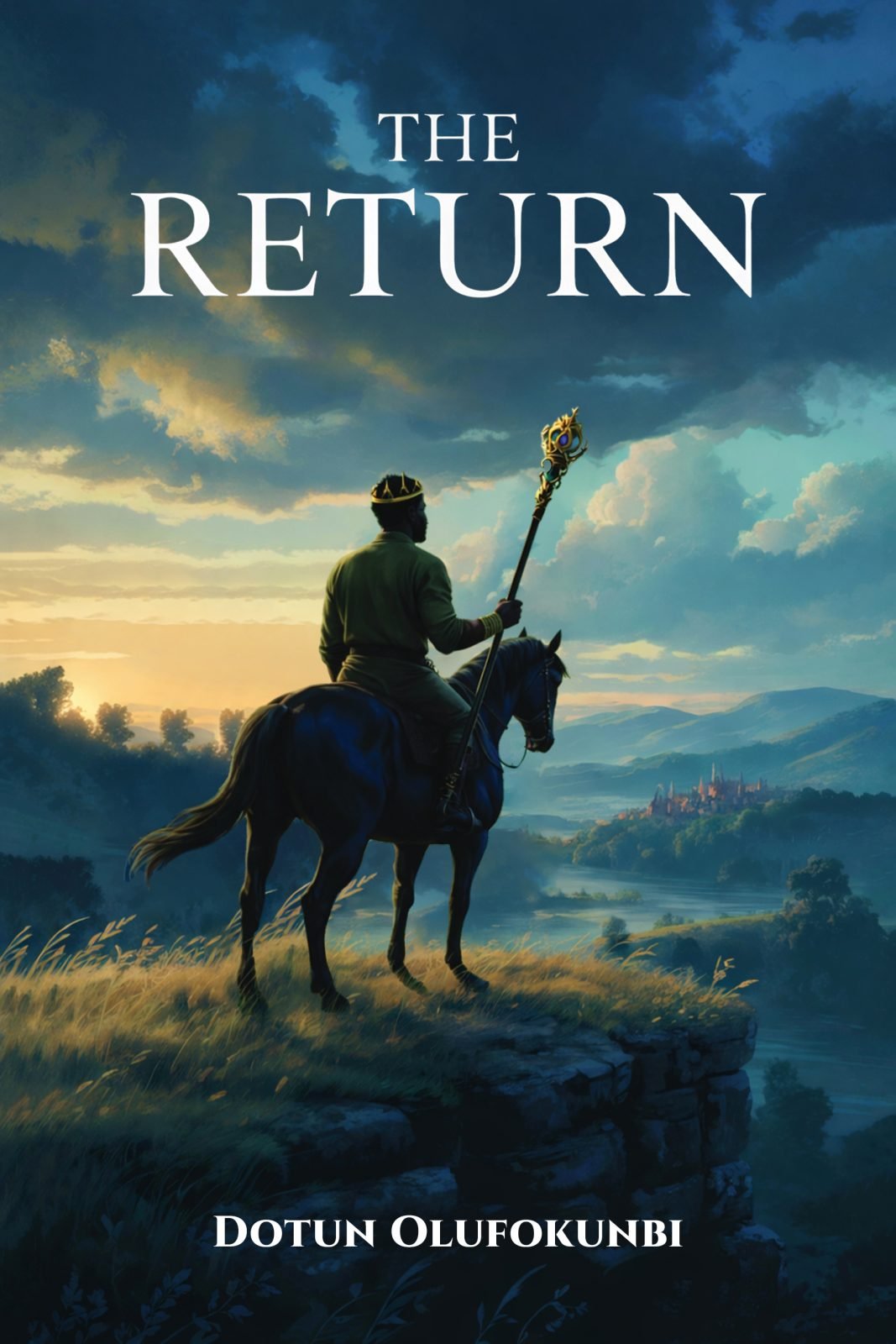
The book's cover shows a crowned rider holding a jewelled staff and looking out over a distant settlement beneath a cloudy sky. The play inside is more crowded and more argued than that quiet image suggests. Readers interested in Yoruba history, in drama written for the stage, or in stories about succession and its costs will find a text that invites them to consider where legitimacy comes from, what counsel is worth and how far pride can carry a man.