
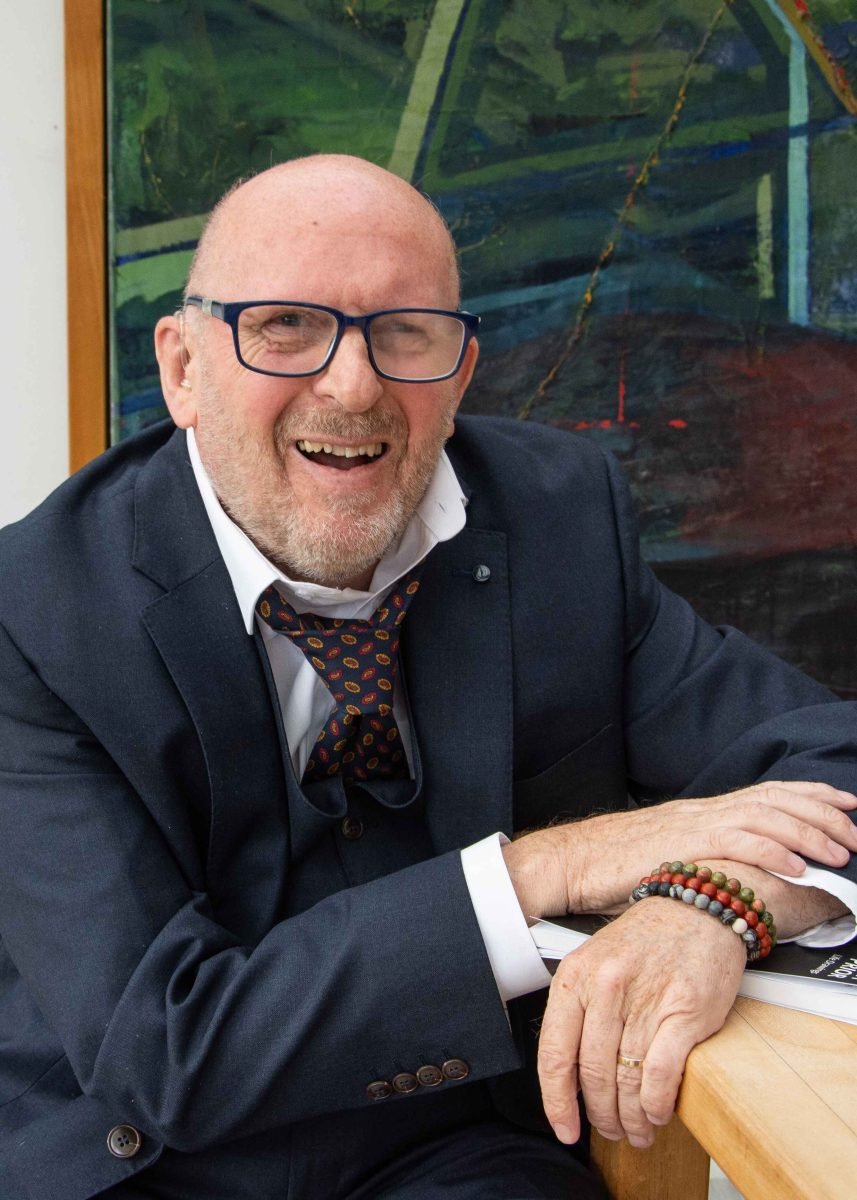
Anthony Peter Prior, Author | A Painter Who Writes, a Writer Who Paints
Some people learn to see with a brush long before they learn to speak with a pen.
Anthony Peter Prior has spent most of his life looking. Long before he set words down on a page, he was a painter, working with colour, shape and composition, and learning to trust what the eye discovers before the mind has named it. That habit of looking has never left him. It now shapes the way he writes, and it explains why his poetry reads less like a set of statements and more like a canvas on which words are allowed to move, collide and settle into their own arrangement.
Based in Stratford-upon-Avon, Anthony Peter Prior describes himself as a painter who writes and a writer who paints. The phrase is more than a neat inversion. In his own account, the two disciplines have become inseparable, each one feeding the other. He has always painted. More recently he has turned to poetry about life experiences, his own above all, and he has begun illustrating his writing, which he says has given his artwork a new form of expression. Both, in his words, matter to him "in a complete way".
His path to the page has been shaped by a handful of encounters he still recalls clearly: a meeting with a celebrated poet when he was fifteen, an art education in Bristol, a summer spent immersed in the work of James Joyce, and a lifelong closeness to the theatre of the town he now calls home. It has also been shaped by living with multiple sclerosis, which has left him partially sighted.
This feature follows that journey. The books that have emerged from it, Abstract Words Are Vitamins and Abstract Words Are Fantasy, are the outcome of a life spent seeing, and then finding a second language for what has been seen.
An Early Lesson in Independence | A Schoolboy Meets Philip Larkin
Some of the most lasting influences arrive early and briefly. For Anthony Peter Prior, one of these came at school, at the age of fifteen, when he met the poet Philip Larkin.
He recalls the advice Larkin gave him with characteristic bluntness: not to listen to his parents. Anyone who knows Larkin's work will recognise the sentiment, which echoes a famous line from his own poetry. For a teenager, hearing it directly from the poet was something else. It was permission, of a sort, to think for himself.
It would be easy to overstate what a single conversation can do, and Prior does not claim that this meeting set his course. What it offers is an early glimpse of a theme that runs through everything he has gone on to make: a resistance to inherited rules and a preference for finding his own way. That instinct for independence, first nudged in a school encounter, would later find much fuller expression in the way he approaches both paint and language.
A Painter First | Art Studies in Bristol
Before he was a writer, Anthony Peter Prior was a painter, and in his own words he has always been one. His formal training came through a BA in Art in Bristol, which he dates to 1979. It was there, he recalls, that he was introduced to leading named artists, an experience that widened his sense of what art could be and how seriously it could be pursued.
Much of his working life has been given over to painting. That long apprenticeship to the visual matters for understanding him as a writer. A painter learns to think in terms of balance, contrast, rhythm and placement. He learns that a composition can hold together even when its parts seem, at first glance, to have no obvious relationship. He learns that abstraction is not the absence of meaning but a different route towards it.
These lessons are visible in the way Prior handles language. His interest in abstraction, which gives his collection its title, comes directly from the studio. In the title poem he writes of abstract art as "a language wealth", and of the "composition balancing act" that holds a piece together. These are a painter's concerns, carried across into words.
Painting also gave him something less tangible: confidence in the value of play. A canvas can be reworked, scraped back and approached again. Prior brings that same freedom to the page, and he has said plainly that he does not want his writing to feel contrived. The discipline he learned in Bristol was never about rigidity. It was about learning to judge when something works.
Joyce and the Freedom of Language | Learning to Write Lyrically
If Bristol gave Anthony Peter Prior his eye, a summer devoted to James Joyce helped give him his voice. He attended the James Joyce summer school and came away, as he puts it, inspired to write in a lyrical style.
What drew him to Joyce was freedom. Prior describes enjoying Joyce's "freedom of expression", the sense that there were no fixed rules and that anything could go. For a painter already comfortable with abstraction, this was a natural meeting point. Joyce showed that language, too, could be broken apart and reassembled, that sound and association could carry meaning alongside sense, and that a sentence need not behave in the way a grammar book expects.
The influence is clear in Prior's writing, though it is an influence absorbed rather than imitated. His poems move by sound as much as by statement. Words chime with their neighbours, rhymes arrive in unexpected places, and phrases are turned over to see what else they might mean. In one poem he describes his aim as pushing limits "until harmony assures my words". In another he declares, with obvious relish, "I want to be free, completely, try stopping me!"
It would be wrong, though, to read this freedom as carelessness. Prior is clear that writing still has to make sense and deliver its content. The playfulness is held in check by an equally strong wish to be understood. That tension between freedom and clarity, between letting words run and making them land, sits at the heart of his approach.
Living in Shakespeare's Town | Stratford-upon-Avon and the Open Stage
Anthony Peter Prior lives in Stratford-upon-Avon, Shakespeare's hometown, and the connection is not incidental to him. He regards Shakespeare as the master dramatist, a figure to admire and to aspire to, and the theatre has long been part of his creative life.
One memory he singles out is Mark Rylance's production of The Tempest staged at the Rollright Stones, the ancient stone circle. Performance in an open, natural setting clearly made an impression, and Prior links it to a wider inspiration: the open and playful stage of the Globe theatre, where actors and audience share the same space and the boundary between them is deliberately thin.
That openness is something he values in his own work. His poems often read as if spoken aloud, with a sense of performance and timing, of a voice addressing a listener and enjoying the effect of a well-placed turn. The comic and the serious sit side by side, much as they do in Shakespeare, and wordplay is treated as a serious tool rather than a distraction.
Stratford also gives him a settled sense of place, and Warwickshire's countryside surfaces in his poems as ground he is glad to return to. For a writer who works so freely with abstraction, that rootedness provides a steady counterweight.
Seeing Differently | Multiple Sclerosis and a New Way of Working
Anthony Peter Prior lives with multiple sclerosis, which has left him partially sighted. He does not drive. He mentions these facts plainly in his own statement, without self-pity, and this feature follows his lead in treating them as part of his story rather than the whole of it.
For an artist whose life has been built around looking, changes in sight carry particular weight. It would be presumptuous to describe what that has meant to him beyond what he himself has said. What can be said is that his creative practice has widened rather than narrowed. Alongside painting, he has turned to writing about his experiences, and he now brings the two together by illustrating his own writing. In one poem he calls himself "a forward mover", and elsewhere he describes heading out on his electric trike, its motor assisting his pedalling up an incline, and the good it does for body and mind.
His poems are candid about the harder seasons of life. They speak of low moods and of struggling to find confidence, and just as often of recovery, of the help of friends, and of the steadying effect of creative work. In one piece he writes of "making order out of abstract disorder", a line that could stand as a description of his whole method. Elsewhere he describes humour and laughter as a way of keeping his chin up.
Public coverage of his work has connected it with mental wellbeing, accessibility and creative expression. Prior's own writing suggests something simpler. It is not inspirational poetry in the greeting-card sense, yet it carries a quiet encouragement: that making things, whether pictures or poems, is how he keeps moving forward.
Abstract Words Are Vitamins and Abstract Words Are Fantasy
A painter's eye, turned towards language.
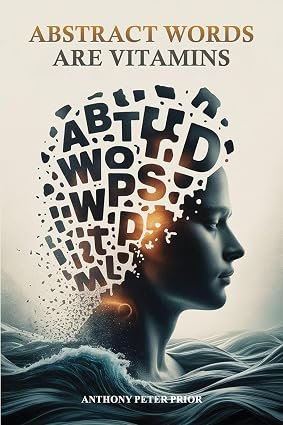
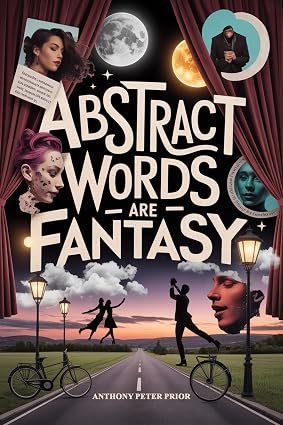
Anthony Peter Prior's journey has so far found its way into two companion volumes: Abstract Words Are Vitamins, published with British Publishers, followed by Abstract Words Are Fantasy. Each is an abstract poetry collection, and together they take their place among contemporary poetry books that value sound and play as much as statement. Both gather short, rhythmic pieces of experimental poetry in which wordplay, humour and reflection sit side by side, and in which the sound of a line matters as much as its literal meaning.
The collections grow directly out of the journey traced above. Their shared title brings together the two things that have defined his creative life: abstraction, learned at the easel, and words, explored more fully since his time with Joyce. Vitamins suggests writing as nourishment, something that sustains him. Fantasy turns towards imagination, performance and the pleasure of make-believe, a natural direction for a writer so drawn to the theatre.
Readers will find in both the qualities that have shaped him for decades: a resistance to fixed rules, a love of play, and an underlying wish to make sense of experience. They are best approached the way one might approach an abstract painting, with attention to rhythm, colour and movement as well as meaning.
Available now on Amazon: Abstract Words Are Vitamins and Abstract Words Are Fantasy
Art and Creative Writing | Where Two Disciplines Meet
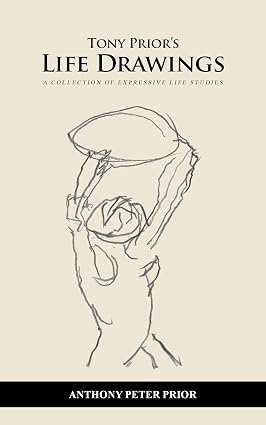
For Anthony Peter Prior, writing has not replaced painting. It has joined it. He describes both as important to him and says that they enhance each other, and his recent practice of illustrating his writing is the clearest sign of how closely the two have become linked.
The relationship runs in both directions. His paintings taught him to think compositionally, and he carries that thinking into his poems, arranging words as a painter arranges forms on a surface. In turn, writing has given his visual work what he calls a new expression, a way of extending what a picture can say.
Many painters write about art. Fewer write as painters, letting the logic of the image guide the logic of the line. In one poem he describes showing off his latest art, a collage of paper pieces stuck on at random until the colours tie together into a smiling face. His poems often work the same way, fragment set beside fragment until meaning emerges from the whole.
He returns repeatedly to the image of a jigsaw: separate pieces that seem to have no order until, gradually, a picture forms. It is a fitting image for a man who has spent his life assembling meaning from colour and shape, and who now does the same with language.
A Voice Built on Play | Rhythm, Rhyme and the Pleasure of Words
Anyone who reads Anthony Peter Prior's poetry will notice, before anything else, the pleasure he takes in words themselves. He enjoys their sound, their double meanings and the sparks they throw off when placed side by side. A single word can be spun through a dozen phrases until its familiar meaning loosens and new ones appear.
This is not play for its own sake. Prior states his principles clearly in his own lines. He does not like writing that feels contrived. He wants writing to make sense, without pretence. He wants readers to "detect a humorous line" combined with something more serious. The result is a voice that is by turns comic and reflective, irreverent and sincere. Readers who usually reach for philosophical poetry books will find serious questions here, though they tend to arrive with a grin.
The humour is very much his own: quick, self-deprecating and rooted in everyday British idiom. Football, the weather, lunch and a first step outside on a bright morning all find their way into his poems, alongside larger questions about confidence, belonging and how to live well. He is as comfortable with a pun as with a moment of real vulnerability, and often places them within a few lines of each other. Much of it reads as poetry of self-discovery and personal growth, written by someone still finding out who he is and enjoying the search.
What holds it together is rhythm. Prior writes with an ear tuned to the beat of a line, and much of his work is best appreciated aloud. In that sense, the influences of Joyce and of Shakespeare's theatre meet on the page: language as music, and language as performance.
In one line he sums up his approach with characteristic economy: "Paradox abstract makes sense to me." It describes a writer at ease letting disorder find its own order.
Welcome to the Author Circle | Anthony Peter Prior
Anthony Peter Prior's journey has taken him from a school encounter with Philip Larkin, through an art education in Bristol and a summer with James Joyce, to a creative life in Shakespeare's town. Along the way, a painter found a second language, and that language has found its way into print in two collections, with more books to come.
His story is one of persistence and curiosity rather than of grand gestures. He has kept looking, kept making and kept finding new ways to express what he sees. Living with multiple sclerosis and partial sight, he has widened his practice rather than narrowed it, bringing painting and writing together so that each strengthens the other.
British Publishers is delighted to welcome Anthony Peter Prior to the Author Circle. We look forward to his forthcoming books and to following the next chapters of a creative life that, by his own account, has always been about freedom, play and the patient work of making sense.
Follow Anthony Peter Prior on Facebook for news and updates.
Author Links
Facebook: Anthony Peter Prior on Facebook
Amazon UK: Abstract Words Are Vitamins
Amazon UK: Abstract Words Are Fantasy
You May Also Like

Kenneth Bryce
History was part of Kenneth Bryce’s intellectual life long before it became the subject of his ficti...


Dotun Olufokunbi
A curious reader, a page of Yoruba history and a question that would not go away.Dotun Olufokunbi gr...
Peter Ridgley
A life recorded, at last, in his own words.Peter Ridgley spent much of his life listening, first to...