

Jennifer Obianuju Orji | From Community Advocacy to the Written Word
For Jennifer Obianuju Orji, the question of whose experience receives recognition is central to both her public work and her writing. Through community advocacy in the North East of England, she has worked to widen opportunities for women and families. As an author, she brings another dimension to that commitment: preserving stories that help readers understand the relationship between achievement, identity and opportunity. Her book, Girl Hero, is a natural point of connection between these two areas of her work. It gives readers a chance to engage with the lives of women whose contributions deserve sustained attention. It also introduces Jennifer as a writer with a distinct interest in the way history can shape our understanding of the present.
The experiences behind the advocate
Jennifer’s published author biography identifies her as the founder of Holding Hands CIC, an organisation concerned with inclusion and empowerment in the United Kingdom. Her work brings her into a field where the challenges people face cannot always be addressed through encouragement alone. A person may have valuable experience but find that qualifications are not readily recognised. Someone may want to return to employment but lack access to technology, suitable training or a local network. Addressing such barriers requires attention to the circumstances in which people live.
This is an important context for understanding Jennifer’s public identity. She has chosen to work in an environment where individual progress is closely tied to the availability of practical opportunities. Her author journey offers readers a way to understand why questions of visibility and access deserve a place in literature as well as in community programmes.
Building connections through Holding Hands
Based in Sunderland, Holding Hands North East provides support to women and others facing difficult circumstances. Its work brings together personal wellbeing and practical development rather than treating them as competing priorities. Digital skills and preparation for employment are among the services associated with the organisation. These activities illustrate the kind of community infrastructure that makes participation possible.
The significance of Jennifer’s role lies not simply in establishing an organisation, but in the way community projects can respond to needs that do not fit neatly within a single category. An individual looking for work may also need a sense of security, a chance to practise unfamiliar skills and opportunities to meet people outside an existing circle. A supportive setting can make those steps more manageable. Such an approach invites a broader definition of leadership: one concerned with removing obstacles and making room for others to develop their abilities.
Recognition as a form of leadership
Much of the work that changes a neighbourhood takes place outside the public spotlight. A volunteer who helps someone navigate an application, a mentor who explains a new process or a community worker who makes a difficult conversation possible may have a lasting effect without becoming widely known. Recognising these efforts is an important part of a healthy community.
In September 2026, local reporting covered the THRIVE 26 programme hosted by Holding Hands Together in Sunderland. Alongside a careers event, the programme included an evening celebrating the contributions of people and organisations in the area. Jennifer was identified as the organisation’s founder and chief executive in that coverage. The occasion offers a concrete example of the relationship between her leadership and her interest in expanding recognition beyond familiar public figures.
The same concern is visible in her literary project. Rather than limiting recognition to a handful of internationally celebrated names, an author can make space for people whose achievements deserve a wider audience.
An approach to opportunity that extends beyond one sector
Jennifer’s interest in public participation has also extended into discussions about creativity. In 2023, reporting on Holding Hands described her interest in working with professionals in Nigeria’s film industry to support the development of emerging talent. The proposal is notable because it places creative work alongside other routes to opportunity, rather than treating the arts as an entirely separate concern. The report documents an intention to collaborate; it does not establish the subsequent outcome of that proposal.
For an author, a connection with creativity has particular significance. Stories are themselves a means of participation in public life. The people whose experiences are published, discussed and remembered help determine how a society explains its past. Making space for a new set of voices can therefore have consequences well beyond the act of producing a book.
From community work to historical storytelling
A community advocate and a biographical writer work with different tools. The former may bring people together, organise support or create routes towards employment. The latter chooses which experiences to present and how to make them intelligible to a reader. Yet both activities involve decisions about who should be heard. Jennifer’s movement into historical non-fiction can be understood through that shared concern, without assuming that a particular event prompted her to begin writing.
Writing about other people brings a special responsibility. An author must give enough attention to the circumstances in which a person acted while avoiding the temptation to turn that life into a simple moral lesson. For readers unfamiliar with an historical figure, the first encounter can influence whether they seek further information. A work of biographical storytelling can open that door without claiming to be the last word on any individual.
Why the next generation matters
In the acknowledgements to Girl Hero, Jennifer identifies her children as an important source of motivation. She also recognises the encouragement she received from people close to her during the creation of the book. Those personal acknowledgements give a clearer sense of the values behind the publication than an invented account of a dramatic turning point ever could.
The intergenerational dimension is particularly meaningful. What children learn about the past can shape the questions they ask about their own futures. A young person who encounters examples of women succeeding in unfamiliar professions may begin to consider options that had not previously seemed relevant. Equally, hearing about the support and resistance that accompanied those achievements can help young readers distinguish an individual accomplishment from the wider conditions that made it difficult.
Jennifer’s concern with legacy can therefore be seen as both personal and public. It connects her responsibilities as a parent with the broader question of how knowledge is passed between generations.
Girl Hero: the book born from a commitment to recognition
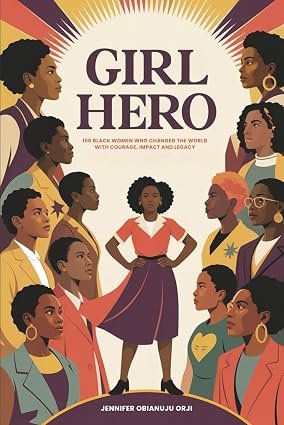
Girl Hero: 100 Black Women Who Changed the World with Courage, Impact and Legacy brings together biographical portraits of women across different periods and fields of achievement. Its subjects range from internationally recognised figures to women whose names may be unfamiliar to many readers. The collection gives Jennifer a literary means of addressing the underrepresentation of Black women in historical narratives. It is designed to be approachable for general readers while providing opportunities for educational discussion. More than a list of achievements, its organising idea is that individual lives can help illuminate wider social change.
Reaching readers through publication
The publication of Girl Hero by British Publishers marks a significant milestone in Jennifer’s journey as a writer. The ebook catalogue records a release date of 23 March 2026, and other retailer listings identify print editions. Publication allows a project conceived around historical visibility to circulate beyond the immediate relationships through which an author normally works.
There is a difference between speaking to a group in person and reaching someone through a printed or digital page. In a meeting, discussion can respond immediately to the needs of those present. A published work, by contrast, can be revisited in the reader’s own time and shared with people the author may never meet. This gives written storytelling a distinctive role alongside Jennifer’s community leadership.
Readers can discover the book through its dedicated Our Books feature and explore how its individual profiles relate to the wider themes of courage, impact and legacy.
The journey beyond the published page
The value of an author profile is not limited to documenting a publication date. It offers an opportunity to understand the interests that connect a writer’s work with the world beyond literature. Jennifer’s public activities and her biographical project illustrate two complementary ways of responding to questions about recognition. One addresses the circumstances in which people seek opportunity today; the other invites reflection on the experiences of women who have helped shape those circumstances over time.
A reader does not need to share an author’s professional background to find something worthwhile in that relationship. Indeed, one of the strengths of writing rooted in public concerns is that it can encourage conversations across professional and generational boundaries. The published book provides a starting point for those discussions, while Jennifer’s broader public work provides context for understanding the interests behind it.
British Publishers Author Circle welcomes Jennifer Obianuju Orji
British Publishers Author Circle is pleased to welcome Jennifer Obianuju Orji and recognise her contribution as an author and community advocate. Her work encourages readers to consider how recognition, access and historical understanding influence the opportunities available to others. Through Girl Hero, she brings together a collection that invites reflection on the lasting significance of Black women’s achievements. We invite readers to explore her published work and discover the stories at the heart of her literary journey.
Books by Jennifer Obianuju Orji
You May Also Like


Dangerous Donald
There is a difference between knowing the sea from a distance and knowing it as a place of work. Dan...