
Kathy Garrett | A Journey from Caregiving and Loss to Writing
Behind Kathy Garrett's writing is a long period of care, companionship and personal change. A registered nurse as well as an author, Kathy draws on her experiences of supporting others and on the loss of her husband after nearly five decades of marriage. Her book Through the Dark Valley grew from the period of reflection that followed bereavement. Its pages explore grief, faith and the enduring importance of love through prose, poetry and opportunities for readers to write about their own experiences. To understand Kathy's work is therefore to begin with the person behind it: someone whose daily life and professional understanding brought her into close contact with the complexity of illness, caring and loss. Her author journey is not presented as a story of effortless transformation. It is a movement from lived experience into the written word, with room for uncertainty and for the different ways people respond to profound change.
The Experiences Behind the Storyteller
The writing journey of Kathy Garrett is closely connected to work that asks people to be present during vulnerable moments. A published account of her background identifies her as a registered nurse with experience of caregiving and patient support. That context matters when considering her literary voice. In nursing, illness is never simply a diagnosis or a sequence of appointments. It changes the rhythms of a household, the conversations people have and the way ordinary time is experienced. Kathy's work as a writer emerges in a field where medical realities and personal relationships can be difficult to separate.
Her experience does not make her reflections a universal account of grief. It does, however, give readers a meaningful point of entry into the concerns that shape her writing: attention to the individual, sensitivity to the experiences of families and an understanding that care involves emotional as well as practical responsibilities. The story behind Kathy Garrett is therefore not a conventional account of an author arriving at a fictional idea. It is the story of a writer seeking language for realities that affected her directly.
A Life That Gave Her Stories to Tell
The published introduction to Kathy's book describes an unusually demanding period of family caregiving. She cared for her husband across sixteen years, with the final stage of his care involving hospice support at home. After almost five decades of marriage, his death altered the familiar shape of her life. Those are intensely personal facts, and they deserve to be understood as experiences rather than turned into dramatic promotional claims. They give the reader a sense of why her writing returns to devotion, fatigue, uncertainty, memory and the changes that come with bereavement.
Long-term caregiving contains both visible tasks and less visible emotional work. Appointments, decisions and daily routines take place alongside hopes, fears and the effort to preserve a person's dignity. A carer can also be a spouse, a companion and someone trying to understand what lies ahead. These overlapping roles help explain the perspective Kathy brings to the page. She writes from proximity to care rather than from a detached interest in the subject. Her published work asks readers to acknowledge the complexity of that position.
From Lived Experience to Writing
Following her husband's death, Kathy began recording her experiences as part of a period of reflection and adjustment. The public account of the book's development describes how personal writing became a way to examine bereavement, rather than an effort to offer easy answers. This distinction is important. Grief does not arrive as a tidy story with a clear beginning and an equally clear ending. Its expression may require fragments, pauses and returning to the same memory from different angles. Writing can accommodate that uneven movement without forcing it into a lesson.
In Kathy's case, her published book combines prose reflections with poetry. These forms allow different kinds of attention. Prose can set out an experience and its context, while a poem may make room for an emotion that resists explanation. The movement from private memory towards a book for readers is an important milestone in her author journey. It turns a deeply individual experience into an invitation to recognise shared human concerns, while leaving space for every reader's circumstances to differ.
Why Kathy Garrett Chose to Write
A public statement attributed to Kathy presents the intention behind her work as making room for people to be honest about grief and supported as they continue living with loss. That is a more precise purpose than simply claiming that she wanted to inspire others. Her writing does not suggest that loving someone should become easier to measure once they are gone. Instead, it considers how love and absence can remain present together, and how a changed life may be approached without denying the person who has died.
Faith is another part of the framework in which Kathy writes. The published description identifies a Christian perspective, including prayer, scripture and spiritual reflection. Yet it also acknowledges uncertainty, frustration and emotional strain. Faith is not presented as a device that removes pain on demand. For readers who share her religious background, this may be a familiar tension. For readers outside that tradition, the significance lies in her willingness to treat grief as something more complex than a problem to be solved.
Caregiving, Nursing and the Human Side of Loss
Kathy's perspective as a registered nurse and a family caregiver gives her writing an unusual intersection of professional understanding and personal involvement. The material publicised for Through the Dark Valley touches on end-of-life care and on misconceptions surrounding hospice provision. Hospice is described in the publication material as support directed towards comfort, dignity and quality of life. That is an important context for a book concerned with the final stages of illness, but it is not the same thing as issuing clinical advice.
What makes this subject relevant to an author profile is the way it shapes the writer's attention. Medical and family experiences do not always fit the usual language of triumph or defeat. Care can require compassion and endurance while also bringing exhaustion, questions and sorrow. Kathy's work places that reality beside the private experience of grieving a spouse. The author who emerges is someone willing to hold more than one truth at once: care can be loving and difficult; faith can coexist with doubt; memories may comfort while also intensifying a sense of absence.
The Voice She Found in Prose and Poetry
Through the Dark Valley brings together two complementary approaches to expression. Reflective prose creates room to revisit what happened and to consider how loss affects daily life. Poetry offers a different scale of attention: a feeling, image or remembrance can be encountered without having to account for every surrounding event. Published descriptions of the book mention emotional states including shock, longing, memory and acceptance. These are not presented as a fixed sequence that every bereaved person must follow, but as experiences that may appear in different combinations.
For Kathy Garrett, using more than one literary form also means refusing to reduce bereavement to a single tone. A reflective passage can be measured and observant; a poem may be direct or unresolved. The two together give the author ways to speak about the ongoing relationship between remembrance and change. Readers may encounter a voice that is compassionate without demanding agreement, and personal without insisting that one story can explain everyone else's.
Milestones Along Kathy Garrett’s Author Journey
The clearest documented milestone in Kathy's literary journey is the publication of Through the Dark Valley and its public introduction to readers in 2026. An announcement dated 31 August 2026 describes the work as available through online retail platforms and explains its combination of grief writing, caregiving reflection, poetry and reader participation. It also identifies Kathy as a writer and registered nurse. These are concrete details that can be included without inventing prizes, sales totals or media recognition.
The book's format is a milestone in another sense. Rather than presenting her reflections as something readers must simply receive, Kathy includes spaces in which they can record responses of their own. That editorial choice fits the purpose described in the published announcement: providing room for readers to engage honestly and at their own pace. It shows an interest not only in what the author has experienced, but also in how others might approach their experiences through reading and writing.
Through the Dark Valley: The Book Born From the Journey
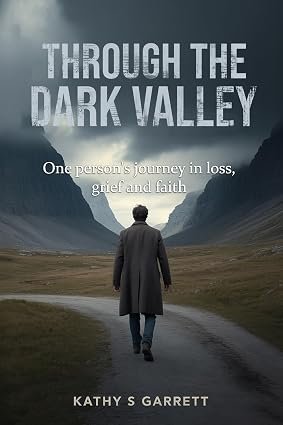
Through the Dark Valley is Kathy Garrett's reflective book about bereavement, caregiving, faith and the emotional adjustment that follows the death of a loved one. Developed after the loss of her husband, the book moves between prose passages, poetry and guided spaces for personal reflection. It draws on her experience of long-term care and home hospice support, while also considering the ways memory and love remain significant after death. The book does not claim to offer a timetable for grief or a universal method for recovery. Instead, its structure gives readers the opportunity to pause, consider their own responses and engage with difficult feelings in a form that respects individual experience. The dedicated Our Books feature explores the book itself in greater depth; here, it stands as a significant expression of Kathy's journey into published writing.
From Written Memories to Publication
Turning private reflections into a published book involves a change of audience. Words first written to make sense of personal experience can be read by someone facing a different kind of loss, at a different stage of life, in circumstances the author cannot know. For Kathy, the move into publication gives her reflections a life beyond the situation in which they began. That does not make the original experience less intimate. It means a reader can encounter it as a perspective rather than as an instruction.
The published description of Through the Dark Valley places particular weight on readers having space to write after each entry. This creates an invitation to respond rather than merely consume. In that respect, the journey from manuscript to publication is also a journey towards dialogue: the author offers what she can truthfully describe, while the reader retains ownership of their own memories, questions and feelings. That is a fitting outcome for a book about a subject as individual as grief.
The Journey Beyond Publication
Kathy Garrett's writing remains connected to themes that do not end with a publication date. Bereavement alters as people live with it, and the meaning of an experience may shift over the years. Through the Dark Valley gives Kathy's reflections a stable form that readers can return to when they choose. Her public author identity, as represented by this book, joins her experience of nursing, care and family life with an interest in language and the value of honest reflection.
No further books or professional plans need to be assumed to recognise this milestone. Her existing work has a clear subject and a particular way of approaching it. It offers a personal voice on loss while making room for the experiences of others.
British Publishers Author Circle Welcomes Kathy Garrett
British Publishers Author Circle welcomes Kathy Garrett as the author of Through the Dark Valley. Her writing brings together the perspective of a registered nurse, the experience of family caregiving and the difficult, continuing work of living with bereavement. Through prose, poetry and reflective space, she approaches grief with care rather than easy promises. The Author Circle is pleased to introduce readers to the writer behind this book and to recognise the personal experiences that led her to put these reflections into published form.
Readers wishing to explore the themes and structure of her work can continue to the dedicated Our Books feature on Through the Dark Valley, where the book takes centre stage.