

Dangerous Donald | From the Sea and Scottish Harbours to Storytelling
There is a difference between knowing the sea from a distance and knowing it as a place of work. Dangerous Donald belongs firmly to the second group. Born in St Andrews, Scotland, he spent his first five years in the Cameroons before returning to Scotland. His later career carried him into the Merchant Navy, where the routines of watchkeeping, movement and responsibility became an important part of his working life.
Donald spent more than twenty years at sea as a deck officer. His service included work with Ben Line Steamers, Gibsons Gas Tankers, Rowbotham Tankers and Sealion Shipping. Those company names describe different chapters of a maritime career, but the broader significance for his writing lies in sustained exposure to vessels, crews and the practical realities of life afloat.
A working ship is a community with its own language, duties and personalities. It demands attention to weather, schedules and the needs of people whose days unfold in close proximity. Donald’s published writing is shaped by this maritime familiarity. Instead of presenting the coast as scenery alone, he can approach it as a living workplace, full of obligations, complications and people whose humour travels with them through difficult days.
A Life That Gave Him Stories to Tell
The sea was not Donald’s only workplace. His published biography describes an unusually varied career that also included a pet shop and poodle parlour, shipboard security work, driving a taxi in St Andrews and running an odd-job business. It is an unlikely combination on paper, yet these occupations share one useful feature for a storyteller: each brings a person into contact with different characters and situations.
Operating a business, taking passengers where they need to go and dealing with practical problems all involve listening, improvising and observing. They offer repeated reminders that everyday life rarely follows a perfectly tidy plan. That sensibility feels particularly appropriate to the world Donald later created on the page, where an ordinary task can become a story because of the people and animals drawn into it.
It would be too simple to suggest that each job directly inspired a specific episode in his book. No approved source establishes such a one-to-one relationship. What can be said is that his working life gave him a broad range of experiences alongside his longstanding connection with the sea. His writing benefits from the perspective of someone familiar with both the seriousness of labour and the humour that helps people get through it.
The Harbour Years: From Relief Duties to a Full-Time Role
Donald’s move into harbour work brought his maritime background closer to the shore. He served as a relief Harbourmaster across eleven Fife Council harbours before taking on a full-time Harbourmaster role. In total, his published biography credits him with twelve years in harbour service, ending with his retirement at the age of sixty-four.
A harbour is a point of meeting. Boats arrive and depart, fishing crews work against the demands of tide and weather, and visitors see a picturesque waterfront that is also somebody else’s demanding workplace. The Harbourmaster has to think about what is happening beneath that charming surface: vessel movements, safety, changing conditions and the practical business of keeping a working harbour functioning.
This professional experience gives Donald an especially distinctive place among writers of Scottish coastal stories. He did not need to imagine harbour routines from the outside. He had spent years attending to the ordinary and occasionally extraordinary things that happen where land meets water. The result is a writer whose subject is rooted in work as well as affection for place.
The Stories That Followed Him Ashore
Some lives develop around a single profession. Donald’s has involved movement between seafaring, harbour responsibilities, local businesses and other occupations. What connects those experiences in his author identity is not a claim of grand adventure at every turn. It is his evident interest in the odd details that make everyday situations memorable.
His published book description and later publicity present a world of changing weather, stubborn characters, fishing activity, wandering visitors and animals that refuse to behave like passive background figures. The value of this material is its scale. An oil slick or a difficult boat can require attention, but so can an apparently minor interruption that becomes comic through its timing and the personalities involved.
Donald’s stories suggest an appreciation of how practical work and spoken humour coexist. Coastal communities can be closely connected and highly individual at the same time. People may disagree about the best way to handle a problem while continuing to depend upon one another. This tension, rather than any invented dramatic turning point, provides a credible bridge between Donald’s working experiences and his literary voice.
From Lived Experience to a Written Voice
A precise date for Donald’s decision to start writing has not been established in the publicly available material used for this profile. Nor is there a verified account of one conversation that persuaded him to become an author. Rather than create such a moment, it is more revealing to look at the voice that eventually appeared in The Harbourmaster, Dougie and His Dug.
Donald’s storytelling is conversational and distinctly Scottish. The collection brings together a Harbourmaster, a sharp-tongued alter ego named Dougie and a Border Collie known as the Dug. Their exchanges allow a familiar scene to be heard from more than one angle. The narrator may attempt to describe a practical task; Dougie can interrupt with a different opinion; the dog’s presence can add another complication altogether.
This technique turns observation into performance. It preserves some of the energy of spoken stories, in which timing, local expressions and the personality of the teller are central to the experience. The writing does not need to abandon its roots in daily life to become entertaining. Its voice emerges from the way that life is remembered and recounted.
The published material presents Donald as a writer who draws on maritime experience, community and animals. It does not give permission to invent his private thoughts about the manuscript. His author journey is better understood through the established relationship between his background and the work readers can now discover.
Why These Harbour Stories Deserve to Be Told
Working harbours are often admired for their appearance. Fishing vessels, stone buildings and coastal views make powerful images, but such scenes tell only part of the story. There are tides to consider, boats to check, crews to communicate with and tasks that rarely wait for an ideal moment.
Donald’s book brings attention to the people who carry out this work. It also gives space to the conversations, mishaps and jokes that rarely appear in a formal account of maritime activity. The stories make room for fishermen, visitors, harbour workers and the animals that become part of local routines.
A second strand is language. The collection uses Scots expressions and the rhythms of a particular place. Spoken language can hold a community’s identity in ways that a neutral, polished description cannot. Donald’s decision to tell the stories in this voice is visible in the published work, even if his personal reasons for that stylistic choice have not been recorded in a direct interview.
The value of the writing is therefore both entertaining and cultural. Readers can enjoy the comedy while also encountering details of local life that might otherwise pass unnoticed. That combination is at the heart of Dangerous Donald’s author identity.
Milestones Along Dangerous Donald’s Journey
The confirmed milestones in Donald’s journey belong first to his working life. He served as a Merchant Navy deck officer for more than twenty years, held a variety of jobs ashore, worked as relief Harbourmaster across eleven Fife Council harbours and subsequently completed a longer period of full-time harbour service. These experiences form a substantial foundation for the subject matter of his book.
A literary milestone followed with the publication of The Harbourmaster, Dougie and His Dug in 2026. Bibliographic records identify British Publishers as the publisher, while the book is listed in the Author Circle catalogue under Dangerous Donald’s name. The work is available to readers through its published editions and Amazon listing.
The available sources do not establish literary prizes, bestseller rankings or other awards, so none should be attached to this milestone. The achievement is concrete enough without embellishment: a body of experiences associated with the Scottish coast has taken the form of a published collection, ready to be encountered by readers beyond the harbour communities that inspired it.
The Harbourmaster, Dougie and His Dug | The Book Behind the Author
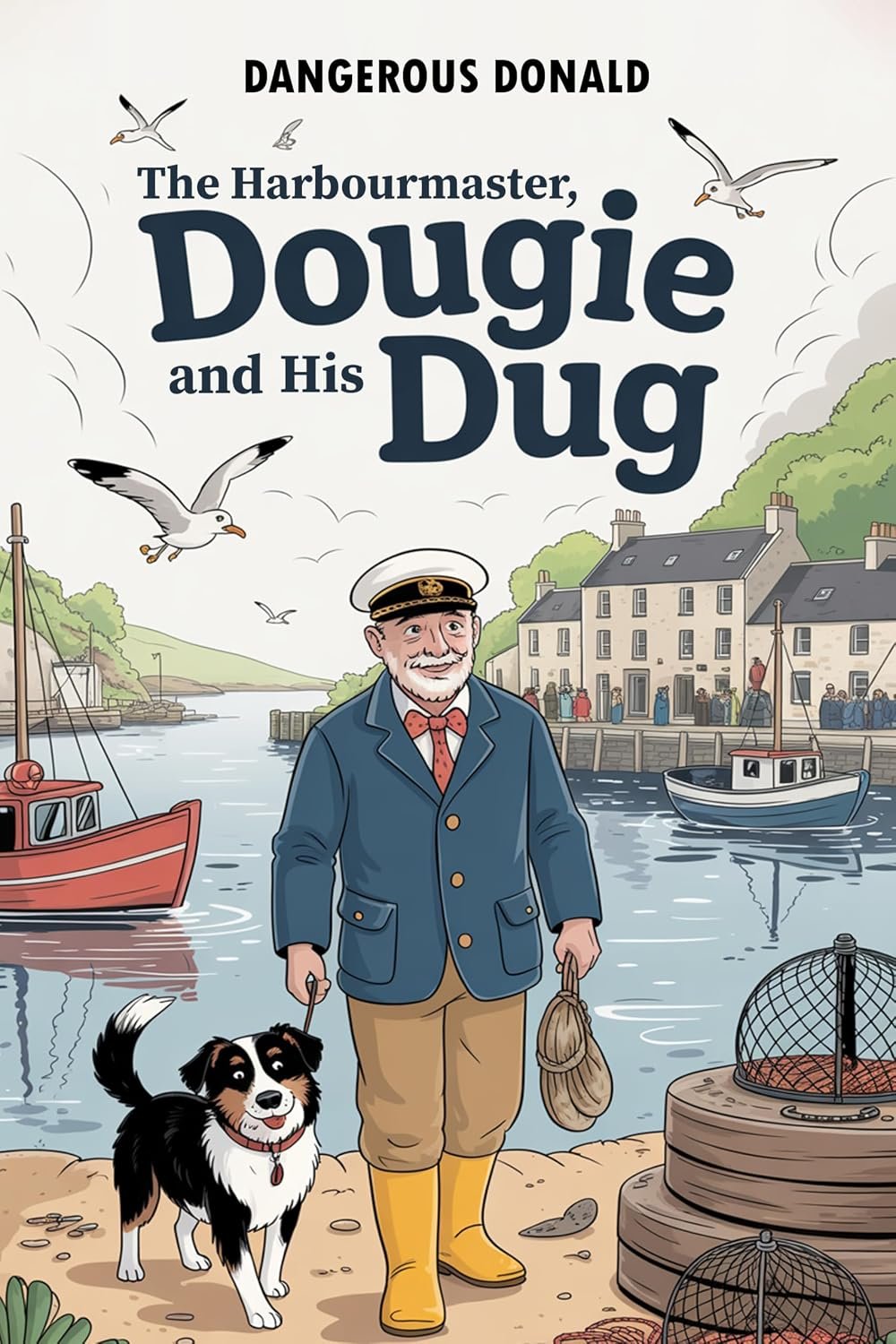
The Harbourmaster, Dougie and His Dug is a humorous collection set in the world of a small fishing town on Scotland’s east coast. Its central company consists of the Harbourmaster, his outspoken alter ego Dougie and a loyal Border Collie, the Dug. Through their conversations and adventures, the book explores the disruptions, personalities and quiet absurdities surrounding a working harbour.
Its landscape belongs to the East Neuk of Fife, but the stories extend beyond scenery. Fishing activity, weather, visitors, local history and animal mischief are all woven into the narrative. The use of Scots dialect helps preserve the sound and personality of the setting. Rather than offering a technical guide to harbour management, Donald invites readers to experience the place through humour, memory and lively observation.
For readers interested primarily in the story, settings and themes, the dedicated Our Books feature explores the collection in greater detail. Here, the book matters above all as the expression of the experiences and storytelling perspective that shaped its author.
From Working Memories to Publication
A book built from the atmosphere of working life does something different from a diary or an official record. It chooses episodes, arranges voices and turns familiar events into material other people can enjoy. In Donald’s case, the finished collection carries the influence of practical maritime knowledge without becoming a manual about boats, tides or rules.
Publication also gives regional speech a lasting form. The Scots dialect used in the book is not an interchangeable decoration; it is part of how characters relate to one another and how the stories create their humour. Readers unfamiliar with that speech can encounter a distinctive voice rather than an entirely standardised version of coastal Scotland.
Public records list the book in 2026, and Author Circle now presents Dangerous Donald as one of its authors. The sources reviewed do not document each editorial or production step, so it would be inaccurate to suggest a precise manuscript timeline. The visible milestone is the arrival of the published work and the opportunity for readers to experience these harbour tales for themselves.
The Journey Beyond Publication
Retirement from harbour service did not sever Donald’s connection with the places and interests that shape his writing. His published biography notes that he continues to pursue creative interests and flies kites at Leven. These details offer a quieter image of a life no longer organised by every demand of a working harbour but still closely connected with the Scottish coast.
The book gives those connections another life. Readers can meet the comic voices of Dougie and the Dug, recognise the practical concerns of harbour work and discover something of the community atmosphere Donald knows. Its impact need not be measured by exaggerated promises. The continuing value lies in the ability of a distinctly local voice to reach an audience elsewhere.
No sequel, new title or future publishing programme has been confirmed in the reviewed material. Dangerous Donald’s present author journey can therefore be celebrated through the work that already exists, without inventing a next chapter.
British Publishers Author Circle Welcomes Dangerous Donald
British Publishers Author Circle is pleased to recognise Dangerous Donald and a storytelling journey shaped by the sea, Scotland’s working harbours and an unmistakable sense of humour. From his Merchant Navy years to his time overseeing Fife harbours, Donald has experienced the practical side of maritime life as well as the personalities that make coastal communities memorable.
Through The Harbourmaster, Dougie and His Dug, those experiences now inform a published collection of stories told in a lively Scottish voice. Readers are invited to discover the author behind the Harbourmaster, meet Dougie and the Dug, and explore a world where work, local history, friendship and unexpected mishaps come together.
Explore Dangerous Donald’s book through British Publishers Author Circle and the official Amazon UK listing.
Books by Dangerous Donald
You May Also Like

Kenneth Bryce
History was part of Kenneth Bryce’s intellectual life long before it became the subject of his ficti...

Ryan Zents
For Ryan Zents, the journey towards authorship cannot be separated from the experiences that changed...