

Ryan Zents | A Life Rebuilt, A Story Told
For Ryan Zents, the journey towards authorship cannot be separated from the experiences that changed the course of his life. His memoir, Still Standing: From Collapse To Clarity, draws on a childhood in Johannesburg, a devastating gunshot injury and the years of adjustment that followed. These experiences are not incidental background to his writing; they are the subject from which his voice as an author emerges. Rather than presenting a neatly resolved account of adversity, Ryan writes from the difficult territory between an event that changes a person’s life and the continuing work of living afterwards.
What distinguishes Ryan’s author journey is the perspective he brings to subjects often described from a distance. Disability, neurological injury, chronic pain and the struggle to rebuild independence are not abstract ideas in his story. They belong to his own account of experience. By putting that account into words, he makes space for a kind of storytelling that recognises both determination and vulnerability. The publication of Still Standing gives readers an opportunity to encounter that perspective through Ryan’s own narrative rather than through assumptions about what survival ought to look like.
The Experiences Behind the Storyteller
The public description of Still Standing locates Ryan’s early life in Johannesburg during the 1980s. It presents a childhood characterised by energy and possibility before a gunshot caused a catastrophic injury. The contrast between those two parts of his early life helps explain why time, identity and change occupy such an important place in the story he eventually chose to tell. The years that followed demanded more than an adjustment to routine; they required him to engage with a future radically different from the one that had seemed available before the injury.
In accounts of traumatic injury, the moment of crisis can easily overshadow the person who lives beyond it. Ryan’s writing gives the longer experience a place in the record. His author identity is therefore shaped not by one dramatic incident alone, but by the prolonged consequences: learning to navigate an altered body, managing pain, encountering barriers and reconsidering what independence might mean. These are the experiences the published synopsis identifies as central to his memoir, and they establish the personal foundation of his storytelling.
A Life That Gave Him Stories to Tell
Ryan’s story did not end when he survived. According to the book description, recovery involved relearning to stand and walk while living with paralysis and brain injury. It also involved difficulties that could not be captured by a single physical milestone: the psychological impact of trauma, the isolation that disability can create and the pressure placed on relationships. As years passed, the accumulated experiences formed the material of a narrative about what it means to remain present in a life that has become more complicated.
His account also reaches into everyday realities. The published overview mentions broken bones, spinal surgery, social rejection and professional setbacks, alongside persistent pain. In an author profile, these details matter because they broaden the understanding of Ryan’s voice. He is not writing only about an extraordinary emergency; he is examining the ordinary days, decisions and encounters through which a changed life is lived. The stories he carries are therefore as much about persistence in daily circumstances as they are about moments that appear remarkable from the outside.
From Lived Experience to the Written Word
The precise date on which Ryan decided to write his memoir, and the private conversations that led to that decision, have not been established in the available publication material. What readers can see is the outcome: he has chosen to frame his lived experience as a sustained first-person story. That choice brings many years of events, observations and emotional consequences into a form that can be shared beyond his immediate circle.
Writing a memoir of this kind requires a different perspective from simply recounting a medical history. A sequence of injuries and treatments may explain what happened, but it does not by itself express what those events meant to the person living through them. Ryan’s work, as described by its publisher and retailers, places recovery beside identity, relationships and purpose. The move from experience to writing allows those strands to sit together. It is a way of giving the reader not just the outline of an event, but a view of its long human aftermath.
Why Ryan Zents Chose to Share His Story
The published synopsis characterises Still Standing as a memoir concerned with survival, resilience and the redefinition of possibility. These themes indicate the direction of the finished work, though they should not be mistaken for a verbatim statement of Ryan’s private motivation. The book offers a perspective on what it is like to be told that certain kinds of independence may be out of reach and to build a life amid uncertainty, changing capabilities and social expectations.
There is significance in recording both visible and invisible difficulties. Readers may understand a physical injury in general terms yet know little about the effects of brain injury on identity, confidence or participation in ordinary life. By giving those experiences a narrative form, Ryan makes them harder to overlook. His account also resists the idea that resilience means the absence of pain. The enduring struggle remains part of the story. That complexity gives the book its human character and helps explain why the writing may connect with readers who have faced their own forms of disruption.
Milestones Along Ryan Zents’s Journey
The available sources establish several meaningful milestones without requiring additional claims about awards or acclaim. Ryan survived a severe injury during childhood, underwent an extensive process of rehabilitation and later documented that experience in a published memoir. Still Standing: From Collapse To Clarity appears in published book listings for 2026, with editions identified in digital and print formats. A separate audiobook edition is also listed, widening the ways readers and listeners may encounter his work.
These milestones should be understood in the context of the larger author journey. Publication is a public marker, but the personal record behind it spans much more than the moment a book becomes available. The achievement lies in turning difficult, highly individual experience into a coherent account. No independently confirmed literary prizes, sales figures or bestseller designations have been found, so the value of Ryan’s work is best described through the substance of the story rather than promotional claims.
Still Standing — The Book Born From the Journey
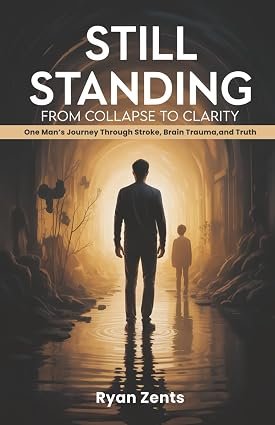
Still Standing: From Collapse To Clarity is Ryan Zents’s memoir of life after a childhood gunshot injury in Johannesburg. It follows the consequences of that event through physical rehabilitation, ongoing neurological and bodily challenges, strained social and professional experiences and the search for purpose. The published description highlights both Ryan’s determination and the steadfast support of his mother and wife. Although it contains a striking survival story, the book’s wider focus is on the longer process of rebuilding identity and negotiating life with disability. It is the work through which Ryan’s personal experiences have found a public literary form.
From Manuscript to Publication
A memoir makes personal history available in a form that can be revisited. Readers can return to passages, weigh what is said and recognise developments that may be difficult to see during the rush of everyday life. For Ryan, publication places his account of injury, recovery and ongoing challenge within that more durable form. It transforms a personal chronology into a work that other people can encounter in their own time.
Public listings identify a 2026 publication of Still Standing and show that the work has reached more than one format, including an audiobook listed under British Publishers. The available material does not establish every step of Ryan’s manuscript development, editing or production schedule. It is therefore more accurate to celebrate the existence of the finished work than to invent a behind-the-scenes account of how it was produced. What is clear is that the published memoir now carries Ryan’s own name and story to readers.
The Journey Beyond Publication
Publication cannot erase the realities described in Still Standing, nor does it need to. Ryan’s author journey continues to matter because the book speaks from within an experience that does not fit the familiar pattern of challenge followed by permanent resolution. Recovery and adaptation are presented as ongoing parts of life. The writing gives those experiences a public voice without asking readers to mistake them for a simple lesson.
For people interested in memoir, disability narratives and the human effects of trauma, Ryan’s account offers an individual perspective rather than a universal prescription. For readers encountering his name for the first time, the book is an introduction to a writer whose subject has been shaped by persistence, loss, support and self-examination. The enduring significance of the publication rests in that opportunity to listen.
British Publishers Author Circle Welcomes Ryan Zents
British Publishers Author Circle welcomes Ryan Zents and recognises the personal journey behind Still Standing: From Collapse To Clarity. His memoir gives readers a window into the visible and less visible consequences of severe injury, while acknowledging the complexity of rebuilding a sense of self over time. The work also reminds us that author journeys take many forms: some begin in creative imagination, while others begin with the decision to record a life lived through extraordinary circumstances.
Through this author profile, readers are invited to discover more about Ryan and the writing that has brought his experiences into print. His place in the Author Circle is an opportunity to recognise the person behind the published work, not only the book’s title. Readers wishing to explore the full account can continue to the dedicated Still Standing book feature.
Books by Ryan Zents
You May Also Like